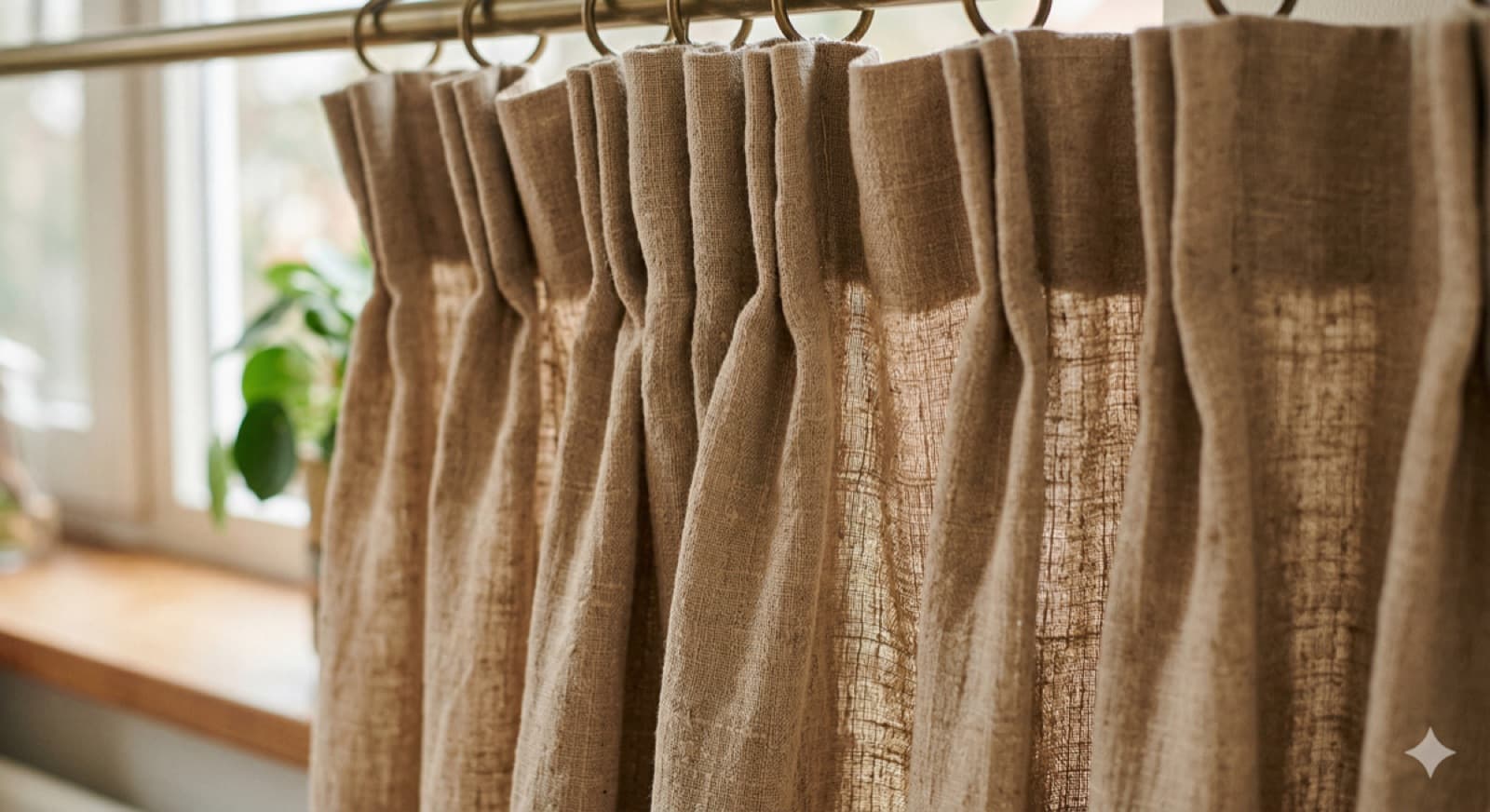
Fullness is one of the numbers that decides whether a curtain hangs well. Too little and the curtain looks thin and flat; too much and you order fabric the customer pays for but never sees. This guide explains how to work out fullness for every common heading — with rules of thumb, the mistakes that cost the most, and worked examples.
In short
- Measure the track, not the window: the window width plus 15 to 20 cm on each side.
- Pick the fullness for the heading from the table below, or take it from the track manufacturer.
- Fabric width = track width × fullness.
- Divide by the width of the fabric and round up to get the number of widths.
- Work out the lining separately, with its own fullness.
What is curtain fullness?
Curtain fullness is the ratio between the flat width of fabric in a curtain and the width of the track it hangs on. A fullness of 2.0 (often written as 2×) means a 300 cm track takes 600 cm of fabric. You always work from the track, not from the window: the track usually extends 15 to 20 cm beyond the window on each side, so the curtain can be drawn clear of the glass.
Fullness decides how many metres of fabric you order, and so the cost price of the quote. Estimate too low and you end up reordering, often from a different dye lot; estimate too high and the quote is dearer than it needs to be.
Fullness by heading
The usual ranges in one table. Below it, where the spread comes from for each heading.
| Heading | Fullness |
|---|---|
| Wave curtain | 2.0 – 2.4 (set by the track system) |
| Pencil pleat | 2.0 – 2.5 |
| Double pleat | 2.0 – 2.2 |
| Triple pleat | 2.5 – 3.0 |
| Goblet pleat | 2.2 – 2.5 |
| Sheer, stretched flat | 1.5 – 1.8 |
| Sheer, gathered or full | 2.0 – 3.0 |
| Roman blind or roller blind | 1.0 |
| Lining | 1.8 – 2.0 |
Wave curtains
Wave curtains run on a dedicated track whose gliders sit at a fixed spacing, which is what gives the even wave. The fullness depends on the track manufacturer and the wave depth, and usually sits between 2.0 and 2.4:
- 60 mm wave: fullness about 2.0
- 80 mm wave (deeper waves): fullness about 2.2
- 100 mm wave (luxury finish): fullness about 2.4
Always check the track's technical data sheet — that value takes precedence over any rule of thumb. The Silent Gliss Wave workroom guide, for example, gives a fullness of about 2.1 to 2.3, depending on the glider spacing (60 or 80 mm) and the number of empty pockets between the hooks.
Pleated curtains
With traditional pleated curtains the pleats are made by hand or with a heading tape, and the fullness depends on the pleat:
- Pencil pleat (narrow, tight gathers): 2.0 – 2.5
- Double pleat (two folds per pleat): 2.0 – 2.2
- Triple pleat (a richer, fuller look): 2.5 – 3.0
- Goblet pleat (wide cup shape): 2.2 – 2.5
The higher the fullness, the richer the drape — and the more fabric goes into the quote. For a customer on a budget, a pencil pleat at 2.0 already gives a professional result.
Sheers and voiles
Sheers are stretched flat or lightly gathered for an airy, translucent effect:
- Stretched flat: 1.5 – 1.8
- Lightly gathered: 2.0 – 2.5
- Full, soft drape: 2.5 – 3.0
Sheers that hang from a track follow the same logic as other pleated curtains. Sheers stretched between two rods or clips need less, because the fabric pulls flat.
Roman blinds and roller blinds
Roman blinds and roller blinds have a fullness of 1.0: you need exactly the finished width of the blind, with nothing extra for pleats, because the fabric is made up flat. Do allow 2 to 4 cm per side for the fixing.
Lining
Lining is worked out separately. It usually takes a fullness of 1.8 to 2.0 — a little less than the face fabric, because lining needs less volume to hang well. If the curtain has a fullness of 2.2 and the lining 1.9, you calculate both from the same track width. Face fabric and lining often come in different widths, so the number of widths can differ per layer.
Motorised tracks
On a motorised track the fullness is the same as on a hand-drawn one. What changes is the minimum curtain width: some motors need a minimum weight or width to run properly, so check the motor's specification. A motorised track also has a fixed end position — make sure the fabric width leaves enough room for the curtain to stack clear of the window.
Common mistakes
- Window width instead of track width: the track is usually wider than the window. Always work from the actual track width, or the curtain comes out too narrow.
- Forgetting the extension beyond the window: to block the light and clear the glass, a curtain hangs 15 to 20 cm beyond the window on each side. Include it in the track width before you apply the fullness.
- A generic ratio instead of the manufacturer's: with wave curtains in particular, the exact fullness depends on the track profile. Use the value the manufacturer gives.
- Forgetting the pattern repeat: with a patterned fabric every width has to start at the same point in the pattern. That takes extra length per width — fullness says nothing about it.
Worked examples
Example 1 — Wave curtain
Track width: 200 cm (including 15 cm beyond the window on each side)
Fullness: 2.0 (60 mm wave)
Fabric width on the roll: 140 cm
Drop: 260 cm + 15 cm for hems and heading = 275 cm
Fabric width = 200 × 2.0 = 400 cm
Widths = ⌈400 / 140⌉ = 3 widths
Total fabric = 3 × 275 cm = 8.25 m
Example 2 — Triple pleat
Track width: 200 cm (window 160 cm + 2 × 20 cm)
Fullness: 2.5 (triple pleat)
Fabric width on the roll: 300 cm
Drop: 240 cm + 15 cm = 255 cm
Fabric width = 200 × 2.5 = 500 cm
Widths = ⌈500 / 300⌉ = 2 widths
Total fabric = 2 × 255 cm = 5.10 m
Example 3 — Curtain with lining
Track width: 180 cm
Curtain fullness: 2.2 → fabric width 396 cm → 3 widths (at 140 cm)
Lining fullness: 1.9 → lining width 342 cm → 3 widths (at 150 cm)
Curtain and lining are worked out separately and made up together.
Rather not do this by hand? The curtain fullness calculator gives you the fabric width, and the fabric usage calculator adds the drop, hems and pattern repeat.
Working it out automatically
Working out fullness, fabric usage and the number of widths by hand for every quote takes time and invites mistakes. In Gordana you set the fullness once per curtain type. For each new quote you enter the measurements and the curtain type, and Gordana works out the fabric usage, the number of widths, the pattern repeat and the price. Read more in curtain shop software for Belgium and the Netherlands.
Frequently asked questions
What is the standard fullness for curtains?
There is no universal standard. For wave curtains, 2.0 is the most common starting point; for traditional pleated curtains the fullness is usually between 2.0 and 2.5, depending on the heading. For Roman blinds it is 1.0.
Does fullness apply to the width or the drop?
Only to the width. The length comes from the finished drop plus an allowance for the hems and the heading, and for a patterned fabric the pattern repeat.
Can I use a higher fullness for a fuller look?
Yes. A higher fullness gives a richer, fuller curtain. It is a style choice to make with the customer, and the fabric cost rises in proportion.
How do I work out fullness for a curtain that covers two windows?
Work from the whole track: both windows, the wall between them and the extension beyond the outer edges. Apply the fullness to that total and treat the curtain as one piece, not window by window.
Want fullness worked out for you?
Gordana calculates fabric usage and the price from your own settings.
Book a free demo